

Why Is My Vape Leaking? 7 Reasons + Simple Fixes (2026 Guide)
Why Is My Vape Leaking? 7 Reasons + Fixes
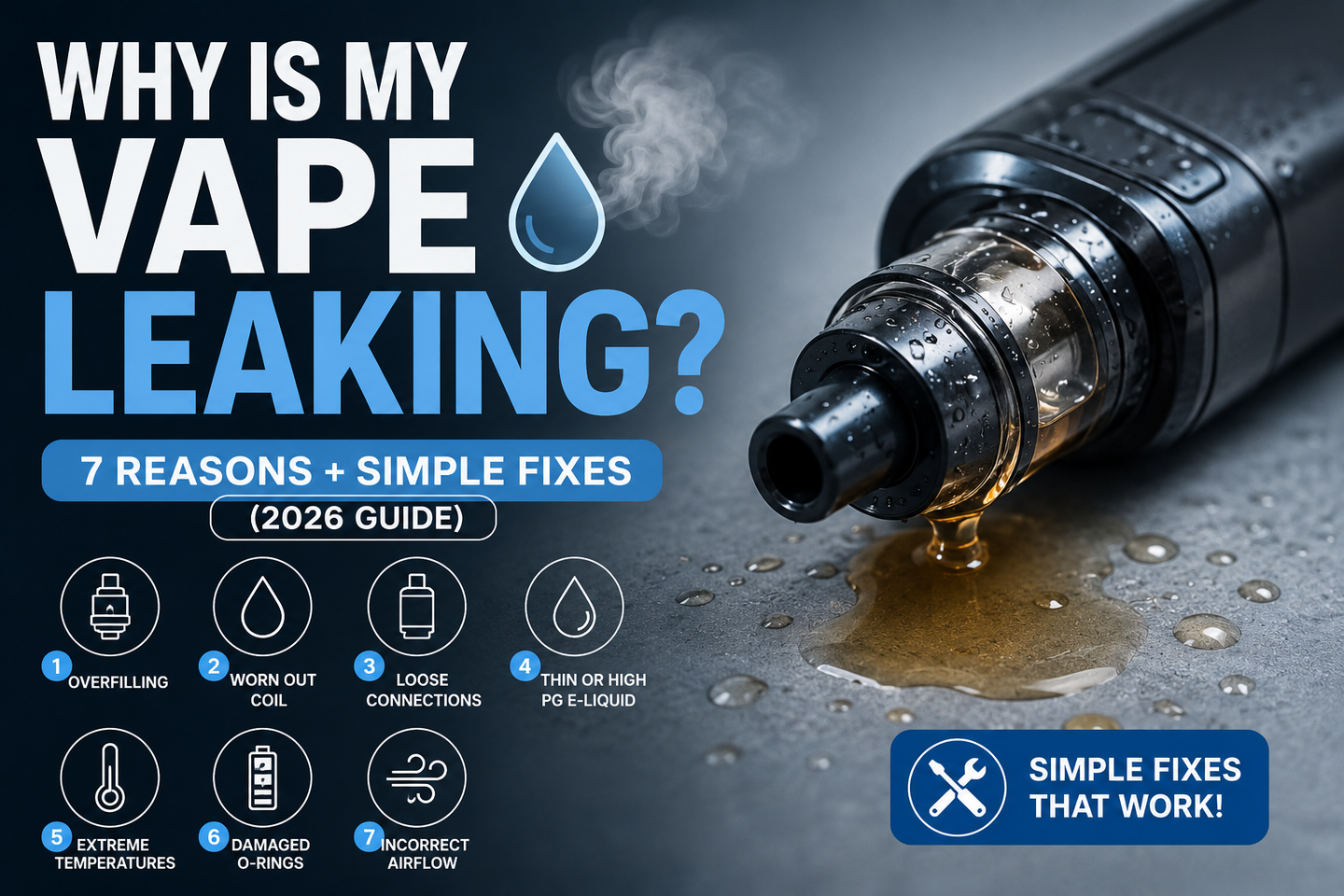
A leaking vape isn't just messy — it wastes e-liquid, can mess with your flavor, and in some cases points to a real fault in your device. The good news: almost every leak traces back to one of a handful of causes, and most are fixable in a couple of minutes without any tools.
In this guide, we'll walk through the seven most common reasons vapes leak, how to tell which one applies to you, and the exact fix for each.
Overfilling the Tank
This is, by far, the most common cause of leaking — especially for people who are new to refillable tanks or pods. Every tank has a max-fill line, and it's usually set a few millimeters below the very top for a reason: it leaves an air pocket. That pocket regulates pressure inside the tank. Fill past the line, and there's nowhere for that pressure to go except out through the airflow vents or the mouthpiece.
The fix: Always fill to the marked line, not to the brim. If your tank doesn't have a visible line, leave roughly 2–3mm of empty space at the top before sealing it back up.
Loose or Misaligned Coil / Pod
If your coil or pod isn't screwed in or clicked into place properly, e-liquid finds the gap and seeps out — often pooling at the base of the tank or dripping from the connection point. This happens a lot after refilling, when people don't fully reseat the coil before screwing the tank back together.
The fix: Disassemble the tank, check that the coil is threaded in fully and sitting flush, then reassemble. For pod systems, make sure the pod clicks firmly into the battery with no wiggle.
Damaged or Missing O-Rings
O-rings are the small rubber seals that sit between the tank's glass, base, and top cap. Over time — especially with regular refilling — they can stretch, dry out, crack, or simply get lost during a refill and never put back. A missing or worn O-ring is one of the sneakier leak causes because everything *looks* assembled correctly.
The fix: Inspect every O-ring on the tank for cracks, flat spots, or stiffness. Most tanks ship with spare O-rings in the box — replace any that look worn. If you're out of spares, most vape shops sell O-ring kits for a few dollars.
Wrong E-Liquid Thickness for Your Device
E-liquid comes in different VG/PG ratios, and that ratio affects viscosity. High-VG juice (typically 70%+ VG) is thick and is made for sub-ohm tanks with large wicking ports. Thin, high-PG e-liquid is made for low-output pod systems with tighter airflow. Put thin juice in a tank designed for thick juice, and it can flood the coil and leak straight through.
The fix: Match your e-liquid to your device. Sub-ohm tanks and RDAs generally want 70/30 VG/PG or higher; pod systems and mouth-to-lung tanks usually do better with 50/50 e-liquid or nicotine salts.
Cracked Tank or Pod
Drops happen. A hairline crack in a glass or plastic tank section is easy to miss at a glance but will leak steadily — sometimes only when the tank is tilted or under pressure during a draw.
The fix: Empty the tank and inspect it closely under good light, glass sections especially. If you find a crack, the section (or pod) needs to be replaced — most tank brands sell replacement glass separately, so you don't always need a whole new tank.
Temperature and Pressure Changes
Ever notice your vape leaks more after a flight, a car ride on a hot day, or moving between a warm room and the cold outside? Air expands when heated and contracts when cooled, and that pushes e-liquid around inside a sealed tank. This is one of the few causes that isn't really a "fault" — it's physics.
The fix: Before flying or any major temperature swing, fill the tank only partway (leave extra air space) or empty it into a bottle entirely. Letting a hot device cool down before opening it also helps.
Worn-Out or Flooded Coil
Coils have a lifespan — typically one to three weeks for sub-ohm coils, longer for pod coils, depending on usage. As a coil ages, its wicking material (usually cotton) degrades and absorbs liquid less efficiently. Liquid backs up instead of vaporizing properly, and it has to go somewhere — often out through the airflow holes.
The fix: If your coil is past its usual lifespan, or you're getting a burnt or muted taste alongside the leaking, replace it. As a rule of thumb, if you can't remember when you last changed it, it's time.
How to Prevent Leaks Going Forward
- Fill slowly and to the line — rushing a refill is the #1 cause of overfilling.
- Let new coils sit for 5–10 minutes after filling before your first puff, so the wick fully saturates.
- Store your vape upright when not in use, rather than lying flat or upside down.
- Replace coils on schedule rather than waiting for performance to drop noticeably.
- Check O-rings every few refills and keep spares on hand.
Looking for a more reliable setup?
Browse leak-resistant tanks, pods, and starter kits in our shop.
Shop Devices & TanksExplore Popular Articles

Lost Mary VIZ 55K vs Nera 70K: Which New Lost Mary Is Better in 2026?
Lost Mary continues to push high-capacity vape technology with newer designs that focus on longer r...

Geek Bar Pulse 2 vs Pulse X (2026): Which 25K Vape Is Better?
The Geek Bar Pulse 2 and Geek Bar Pulse X are two high-capacity devices designed for adult consumer...

Geek Bar Burj 80K Review (2026): Is This the Ultimate High-Capacity Hookah Vape?
The Geek Bar Burj 80K takes the familiar disposable vape concept and moves it into a completely dif...

The Ultimate Mr Fog Buyer's Guide 2026: Every Model Compared
⚠ WARNING: Nicotine products contain an addictive chemical. Adults 21+ only. The Ultimate Mr Fog...