

Disposable Vape Buying Guide: How to Choose the Right Vape
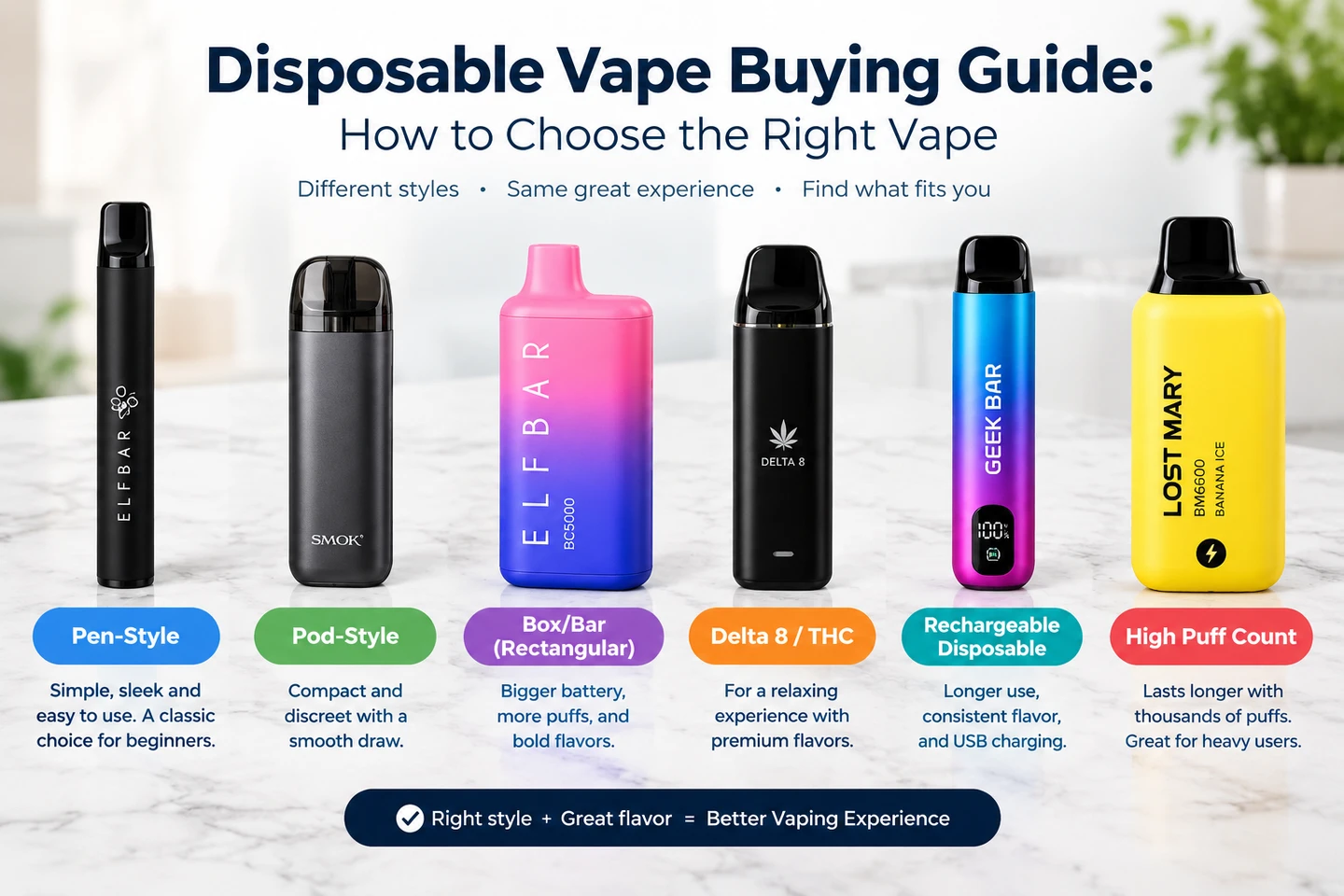
Choosing a disposable vape is no longer as simple as picking a flavor and a puff count. Modern devices can differ significantly in battery capacity, coil technology, nicotine strength, airflow, charging, display features, operating modes and overall design.
This Disposable Vape Buying Guide explains the specifications that matter most and shows you how to compare different devices before making an informed decision. Whether you are comparing a 5,000-puff device with a 25,000-puff model or trying to understand the difference between mesh and dual mesh coils, the goal is to make product specifications easier to understand. Once you know what to look for, you can browse a wide range of disposable vapes to find a device that matches your preferences.
Important: Most e-cigarettes contain nicotine, which is addictive. E-cigarettes are not intended for people who do not already use tobacco or nicotine products, and they should not be used by youth or during pregnancy. Laws governing the sale and use of nicotine products vary by location.
What Is a Disposable Vape?
A disposable vape is a type of electronic cigarette that comes pre-filled with e-liquid and is designed around a self-contained device. Unlike traditional refillable systems, disposable devices are not designed to be refilled.
Modern disposable vapes can include rechargeable batteries, digital displays, adjustable airflow, mesh coils, multiple operating modes and other features that were once more commonly associated with larger vape systems.
The term "disposable" therefore does not always mean that the battery cannot be recharged. Some newer devices are rechargeable but remain non-refillable.
Disposable Vape Specifications at a Glance
| Specification | What It Means | Why It Matters |
|---|---|---|
| Puff Count | Manufacturer's estimated number of puffs | Provides an indication of device capacity |
| Nicotine Strength | Amount of nicotine in the e-liquid | Determines nicotine concentration |
| Battery Capacity | Usually measured in mAh | Indicates electrical storage capacity |
| Coil | Heating element used to vaporize e-liquid | Affects heating characteristics and vapor production |
| Airflow | Controls the amount of air entering the device | Changes draw characteristics |
| Charging | Recharge method and charging connection | Determines whether the battery can be recharged |
1. Understand the Puff Count
Puff count is one of the first specifications people notice when comparing disposable vapes. Devices may be marketed with ratings such as 5,000, 10,000, 20,000, 25,000 or even 50,000 puffs.
However, a puff rating should be treated as a manufacturer estimate rather than a guaranteed number of inhalations. Testing conditions can differ from real-world use, and puff duration, frequency and device mode can all affect actual consumption.
What Does "Up to 25,000 Puffs" Mean?
When a manufacturer states "up to" a particular puff count, the number generally represents a maximum or test-based rating under specified conditions. It should not be interpreted as a guaranteed lifespan for every user.
Does a Higher Puff Count Mean a Better Device?
Not necessarily. Puff count describes capacity, not overall product quality. Two devices with very different puff ratings can also differ in nicotine concentration, battery size, coil configuration, airflow, display technology and physical size.
A better comparison starts with the complete specification sheet rather than focusing on one number.
2. Check the Nicotine Strength
Nicotine strength tells you the concentration of nicotine in the e-liquid. It may be displayed as a percentage or in milligrams per milliliter.
| Percentage | Approximate Concentration |
|---|---|
| 2% | 20 mg/mL |
| 3% | 30 mg/mL |
| 5% | 50 mg/mL |
Nicotine salt formulations are common in many modern disposable and pod-style products. CDC notes that nicotine salts can allow high levels of nicotine to be consumed with less harshness than freebase nicotine.
Because nicotine is addictive, nicotine concentration is an important specification to understand rather than simply choosing a product based on flavor or puff count.
3. Look at the Battery Capacity
Battery capacity is generally expressed in milliamp-hours, or mAh. You may see specifications such as 500mAh, 800mAh or 1000mAh on rechargeable disposable devices.
A higher mAh rating means the battery has greater electrical storage capacity, but it does not automatically determine how long a device will last. Power output, coil resistance, operating mode, puff duration and other hardware characteristics also affect battery consumption.
Battery Capacity vs Puff Count
Puff count and battery capacity should be viewed together. A device may advertise a very high puff count but still use a different battery configuration than another device with a lower puff rating.
When comparing devices, look at both specifications instead of assuming that the largest puff number automatically means the longest battery life.
4. Mesh Coil vs Dual Mesh vs Traditional Coils
The coil is the heating element responsible for turning e-liquid into aerosol. Modern disposable vapes commonly use mesh or dual mesh coil designs.
What Is a Mesh Coil?
A mesh coil uses a mesh-style heating element rather than a traditional wire configuration. Its structure provides a broad heating surface and is widely used in modern vape hardware.
What Is a Dual Mesh Coil?
A dual mesh system uses two mesh heating elements. Manufacturers commonly use this configuration to support increased heating surface area and vapor production.
Coil resistance can also vary. For example, a specification such as 0.6Ω or 0.8Ω describes electrical resistance. It should be considered alongside the device's power system and coil design rather than interpreted on its own.
5. Consider Adjustable Airflow
Airflow controls how much air enters the device during a draw. Some disposable vapes use fixed airflow, while newer models may include an adjustable airflow system.
Adjustable airflow allows the draw characteristics to be changed within the range supported by the device. When comparing two models, check whether airflow is fixed or adjustable and how the adjustment mechanism is implemented.
6. Rechargeable vs Non-Rechargeable Disposable Vapes
One of the biggest changes in the disposable vape category is the increasing number of rechargeable devices.
A rechargeable disposable vape can have a built-in battery that is recharged through a charging port while the device itself remains pre-filled and non-refillable.
Key Difference
- Non-rechargeable: The built-in battery is not designed to be recharged.
- Rechargeable: The built-in battery can be recharged using the manufacturer's specified charging connection.
- Refillable: The device is designed to accept additional e-liquid. This is different from a rechargeable disposable.
7. Understand USB-C Charging
USB-C has become common on rechargeable vape devices. However, the presence of a USB-C port does not tell you everything about charging performance.
When reviewing a device, check whether the manufacturer specifies charging speed, charging requirements and whether the included hardware supports the stated charging capability.
Always follow the manufacturer's charging instructions and use compatible charging equipment.
8. Compare Flavor Options
Flavor is one of the most visible differences between disposable vape products. Manufacturers may offer fruit, menthol, mint, beverage, candy-inspired and tobacco-style flavor profiles.
Rather than judging a device only by the number of flavors available, look at whether the manufacturer clearly identifies the available options and whether the specific flavor is available for the model and market you are considering.
9. Look for a Digital Display
Many newer disposable vapes include screens that provide information about the device. Depending on the model, a display may show battery information, operating mode, puff information or other device indicators.
A screen can make device information easier to monitor, but it is a feature rather than a measure of overall product quality. Compare what the display actually shows rather than simply looking for the word "screen" in a product description.
10. Understand Operating Modes
Some newer disposable vapes include multiple operating modes. A common example is a standard or Regular Mode alongside a more intensive Pulse or Boost Mode.
Different modes can change power delivery and therefore affect battery and e-liquid consumption. Manufacturer puff ratings may also differ between modes.
If a product offers multiple modes, check the manufacturer's specifications for the puff rating and operating characteristics of each mode instead of assuming the headline number applies to every setting.
11. How to Compare 5,000 vs 10,000 vs 20,000 vs 50,000 Puffs
| Puff Rating | What to Check | Important Note |
|---|---|---|
| 5,000 | Battery, coil, nicotine strength and charging | Puff count is an estimate |
| 10,000 | Battery capacity and e-liquid capacity | Actual lifespan varies by use |
| 20,000 | Rechargeability, airflow and coil design | Mode can affect consumption |
| 50,000 | Battery, modes, display, coil and manufacturer rating | Very high ratings require careful specification comparison |
12. Don't Confuse Puff Count With Battery Life
One of the most common mistakes when comparing disposable vapes is assuming that the puff rating directly represents battery life.
Puff count depends on more than the battery. Coil resistance, power output, puff duration, operating mode and e-liquid delivery all contribute to how a device performs and how quickly its resources are consumed.
A device with a large puff rating can therefore have a very different battery specification from another device with a similar headline number.
13. Check the Product's Authenticity
Counterfeit and unauthorized products are an important consideration when purchasing or evaluating branded vape products. Packaging can contain security labels, QR codes, scratch-off codes or authentication systems depending on the manufacturer.
If a manufacturer provides an official authentication page, use that source rather than relying on an unrelated verification website.
Also check the packaging for inconsistent branding, damaged seals, unusual printing, spelling errors or specifications that do not match the manufacturer's official product information.
14. Check the Legal Status in the United States
Product availability and legal marketing status are not the same thing. In the United States, the FDA maintains a current list of e-cigarette products authorized to be marketed. The agency states that products not on the authorized list may not lawfully be sold in the U.S.
FDA also makes an important distinction between authorization and safety: an FDA-authorized tobacco product is not necessarily "FDA approved" or considered safe.
Because regulations and product authorization status can change, consumers should check current federal, state and local requirements rather than relying on an old article or product listing.
15. Read the Complete Specification Sheet
A product title might highlight one specification, such as "50,000 puffs," but that number tells only part of the story.
Before comparing two devices, collect the complete specifications:
- Puff rating
- Nicotine concentration
- Battery capacity
- Rechargeability
- Charging connection
- Coil type
- Coil resistance
- E-liquid capacity, when disclosed
- Airflow configuration
- Operating modes
- Display features
- Authentication and manufacturer information
Common Mistakes When Comparing Disposable Vapes
- Choosing only by puff count. Capacity is only one specification.
- Assuming every puff rating is guaranteed. Manufacturer testing conditions and individual usage differ.
- Ignoring nicotine strength. A device's nicotine concentration is an important part of its specification.
- Assuming rechargeable means refillable. Many rechargeable disposables remain pre-filled and non-refillable.
- Ignoring the coil. Coil design and resistance can influence the device's heating characteristics.
- Relying on third-party specifications without checking the manufacturer. Retailer listings can contain outdated or conflicting information.
- Ignoring local regulations. Federal, state and local rules can affect which products may legally be sold or used.
A Simple Disposable Vape Comparison Checklist
When comparing two products, use this checklist instead of looking at the product title alone:
☐ Puff rating checked
☐ Nicotine strength checked
☐ Battery capacity checked
☐ Rechargeability checked
☐ Coil type checked
☐ Coil resistance checked
☐ Airflow checked
☐ Operating modes checked
☐ Charging method checked
☐ Flavor options checked
☐ Manufacturer authentication checked
☐ Current legal status checked
Final Thoughts
Choosing between disposable vape products is easier when you look beyond the headline puff number. Modern devices can have substantial differences in battery capacity, coil technology, nicotine concentration, airflow, charging and operating modes.
The most useful approach is to compare the complete specification sheet and verify important information through the manufacturer's official product documentation. Puff ratings should be treated as estimates, nicotine concentration should be checked carefully, and rechargeable should not automatically be interpreted as refillable.
For U.S. consumers, legal marketing status is another important part of the research process. Product availability can change as federal and state regulations develop, so current official information should take priority over outdated product listings.
Frequently Asked Questions
What should I look for when comparing disposable vapes?
Compare puff rating, nicotine strength, battery capacity, rechargeability, coil type, airflow, charging method, operating modes, display features and manufacturer information.
Does a higher puff count mean a disposable vape lasts longer?
A higher manufacturer-rated puff count indicates greater stated capacity, but actual duration depends on individual usage, puff duration, operating mode and other device characteristics.
What does mAh mean on a vape?
mAh stands for milliamp-hours and is a measure of battery capacity. It indicates how much electrical charge a battery can store under specified conditions.
Are rechargeable disposable vapes refillable?
Not necessarily. A rechargeable disposable can have a rechargeable battery while remaining pre-filled and non-refillable.
What is a mesh coil?
A mesh coil uses a mesh-style heating element to heat e-liquid. Mesh technology is commonly used in modern vape devices.
Are e-cigarettes safe?
Public-health agencies state that e-cigarettes are not risk-free. Most contain nicotine, which is addictive, and aerosol can contain potentially harmful substances. People who do not use tobacco products should not start using e-cigarettes.
Explore Popular Articles
MR FOG ELITE 5000 Review: A Closer Look at This High-Puff Disposable Vape
The MR FOG ELITE 5,000 Puffs is a compact disposable vape built around a straightforward design, me...
Disposable Vape Buying Guide: How to Choose the Right Vape
Choosing a disposable vape is no longer as simple as picking a flavor and a puff count. Modern devi...
GEEK BAR PULSE X2 vs PULSE 2: Complete Comparison
The GEEK BAR PULSE X2 and GEEK BAR PULSE 2 are two high-capacity disposable vape models built aroun...
Lost Mary VIZ 55K vs Nera 70K: Which New Lost Mary Is Better in 2026?
Lost Mary continues to push high-capacity vape technology with newer designs that focus on longer r...